Wednesday, May 25, 2011

New Postage Stamp Honours Parks Canada

On Thursday, May 19, 2011 it was one hundred years ago to the day that Parks Canada was created.

At Fort Anne National Historic Site in Annapolis Royal it was reason to celebrate as site manager Lillian Stewart and Canada Post local area manager Marcia Longley-Caroppi unveiled a stunningly beautiful and vivid commemorative stamp to mark the historic centennial of the world’s first national parks system.

In 1917 Fort Anne became Canada’s first national historic site.

“It is therefore fitting that we are here today to celebrate the 100th anniversary of Parks Canada – the world’s first national parks service – with the launch of a commemorative stamp,” Longley-Caroppi said to a small crowd that had gathered for the event.

Stewart said Parks Canada was delighted to work with Canada Post to unveil the commemorative stamp, adding that the launch also signifies the beginning of a summer filled with special activities to help celebrate the centennial anniversary.

“Parks Canada manages one of the finest and most extensive systems of protected natural and historic areas in the world and we hope that you’ll be able to return to visit here, and other Parks Canada places this summer,” Stewart told those in attendance.”

Longley-Caroppi said that in Canada we tend to be a bit spoiled when it comes to beautiful lakes, majestic mountains, and well-preserved historic sites – “we have so many.”

In fact, Parks Canada looks after 42 national parks, 167 national historic sites, and four national marine conservation areas.

“Most Canadians relate to our national parks by remembering vacations they experienced there,” said Longley-Caroppi. “That’s why Tim Nokes, who designed the Parks Canada stamp, decided to take a retro approach. If you’ve ever seen any of the famous CP Rail posters from the 1920s and 1930s, you’ll recognize the evocative style of illustration that inspired the design of the stamp.”
It features bold, vibrant colours and strong compositional elements.

“It’s meant to project a sense of freedom and evoke a sense of self-discovery, education, and inspiration from nature,” Longley-Caroppi said.

The stamp depicts a hiker with walking stick in the foreground with a stream running towards him from far-away mountains. A moose grasses in the middleground.

After Longley-Caroppi and Stewart unveiled a large, framed version of the stamp, those gathered also enjoyed slices from a Parks Canada centennial cake handed out personally by Stewart.

The event was preceded by live entertainment and was officially opened by Town Crier Peter Davies.

Looking for a Canada Stamp Album? Try www.boscastlesupplies.com

Source: http://www.novanewsnow.com/News/2011-05-24/article-2532310/Stamp-honours-Parks-Canada/1

Thursday, May 19, 2011

William and Kate Royal Stamps - It's all about the hats


Italian-made shoes
Catherine Middleton can be seen wearing two different hats in the border of this Isle of Man souvenir sheet issued shortly after the announcement was made of the royal engagement.
While all eyes and television cameras were on Catherine Middleton as she walked down the aisle wearing a designer ivory gown with an eight-foot train, it was hard to miss the sea of hats worn by guests at the April 29 royal wedding in Westminster Abbey.

An Associated Press story from London began: "It's all about the dress – and the hats.

"Floppy, feathered, bold and expensive – hats were in full force Friday as guests streamed into Westminster Abbey for Prince William and Kate Middleton's wedding."

Hats also can be seen in full force on many stamps commemorating the engagement of Catherine and William.

In fact, a hint of the hats to come are found on the first souvenir sheet announcing the engagement. The Isle of Man issued this sheet Nov. 26, 2010, just 10 days after the Nov. 16 engagement announcement. While the two £1.50 stamps in the sheet reproduce black-and-white photographs of Prince William, the selvage shows a montage of color photographs, including two of Catherine wearing hats.

In the center of the sheet, she is wearing a black wide-brimmed hat while attending an Oct. 23, 2010, wedding in Cheltenham, England. The United Kingdom web site of the fashion magazine Marie Claire reported, "Her wide brimmed hat wasn't perhaps the best choice for a windy day, but Kate simply giggled and held tight when the wind threatened to dislodge her headgear."

Civic Values
Catherine Middleton wore a black-and-white feathered hat created by Philip Treacy to the 2008 ceremony in which Prince William was installed in the Most Noble Order of the Garter. The hat is shown on a souvenir sheet from Canouan, an island of the St. Vincent-Grenadines.
Another photograph shown on the Manx sheet pictures a feathery creation by Irish designer Philip Treacy, which Catherine sported at a 2006 wedding.

London milliner Treacy also designed more than 30 of the hats worn by guests at the recent royal wedding. In addition, his creations can be seen on a 65-penny stamp in Great Britain's 2001 Hats set and on a €0.82 stamp in Ireland's 2010 Irish Fashion Designers set.

Sierra Leone and Union Island also issued Royal Engagement stamps showing Catherine in this feathery hat by Treacy.
Road Safety
The hat worn by Catherine Middleton on this stamp from Antigua and Barbuda has made at least two public appearances: Catherine wore it to a wedding and her mother wore it to the races at Ascot.
The previously mentioned broad-brimmed hat, though, is perhaps the most popular on the Royal Engagement stamps.

At last count, it appeared on stamps of Antigua & Barbuda, Bequia, Guyana, Liberia, Micronesia, Mustique, Nevis, St. Kitts and St. Vincent-Grenadines. (Bequia and Mustique are islands of the St. Vincent-Grenadines. Other such islands that issued Royal Engagement stamps include Canouan, Myreau and Union Island.)

diverse topics
Catherine Middleton chose a fur hat for warmth while attending the Cheltenham races in 2006. The Cook Islands is among the postal administrations showing her in this mink hat.
The $3 stamp from Nevis is from an unusual souvenir sheet issued Dec. 10.

The sheet contains four stamps inside a perforated circle. The center stamp also is circular, surrounded by the other three stamps. One of these reproduces a photograph of Catherine in another Treacy hat. This black hat with a heart-shaped loop was part of Catherine's attire at Prince William's 2006 graduation from Sandhurst Military Academy. For other glimpses of this hat, see stamps of Canouan, Guyana, Mustique and Sierra Leone.

Catherine chose another Treacy hat for the June 16, 2008, ceremony in which Queen Elizabeth II appointed Prince William a knight of the Most Noble Order of the Garter, a chivalry order that dates back to 1348. The black-and-white feathered hat tops Catherine's head on stamps of Canouan, Montserrat and Myreau.
Fingers
In 2007, Catherine Middleton wore a beret to the Cheltenham races. On a stamp from The Gambia, a photograph from this event is superimposed on a photograph of Big Ben at night.
A stamp from Penrhyn depicts her in a black hat at a wedding in 2005, while stamps of Antigua and Barbuda, Canouan, Grenada and Mustique show her in a white straw hat with lavender feather flowers at a wedding in 2009. Her mother, Carole Middleton, later borrowed the white hat for the races at Ascot.

On less formal occasions, Catherine has adopted styles of other countries: a French beret, Russian fur hat and a leather Australian bush hat. So far, the last-mentioned hat has only made one stamp appearance, on a $225 stamp from Guyana. Although this denomination seems extraordinarily high, it is the equivalent of $1.10 in United States currency.
Fingers
The "something borrowed" worn by Catherine Middleton during her April 29 wedding to Prince William was a Cartier-made tiara loaned by Queen Elizabeth II. A stamp from Australia shows a photograph from the ceremony.
The mink fur hat helped keep her warm at the Cheltenham Festival Races on March 17, 2006. Scenes from that day are captured on photographs reproduced on stamps of the Cook Islands and Grenada-Grenadines.

The following year (2007), Catherine selected a chocolate-color beret for the same event. On a 40-dalasy stamp from The Gambia, Catherine and beret are pictured in the foreground with Big Ben at night in the background. Stamps of Aitutaki, Grenada-Grenadines, Liberia, St. Kitts and Union Island also depict the beret.

No doubt, many more stamps will show Catherine and her headwear, particularly the tiara she wore during the wedding ceremony. In fact, just a few days after the wedding, Australia Post issued a stamp reproducing a photograph taken during the ceremony with the prince in uniform and the new Duchess of Cambridge in her gown and tiara. Loaned to Middleton by Queen Elizabeth, the tiara was made by Cartier in 1936.


Go to www.boscastlesupplies to get stamp supplies for your collection - quality stamp albums and stockbooks - we ship worldwide with great oprices and service

Source: linns.com

Tuesday, May 17, 2011

Stanley Gibbons is Selling a Single and very Rare Canadian Stamp for £110,000

If you can spare the cash here's the Stanley Gibbons sales pitch - I suppose if I were a billionaire then I'd buy it in a flash!
In fact, just 28  Commonwealth stamps are catalogued at over £100,000 at the moment. Just 28  stamps from 109 stamp issuing countries or regions across 160 years since 1847, and some of those are  errors rather than basic stamps.

We have only  handled five of these items in the last 30 years. Due to the nature of the  market it is very rare that we are able to offer you a Commonwealth stamp of such magnitude.

But, let me tell you about one  particular Commonwealth stamp that you have the chance to own...

The stamp is available  to buy for £110,000. At that price and coming from Stanley Gibbons, you know immediately that it is  very rare and very special. This could be a once in a lifetime opportunity. The  stamp in question has not been on our books for over 30 years.

With only about  50 unused examples known to exist (10 of which are in horizontal pairs), its  scarcity and desirability is easily explained.

The stamp is one  of the first postage stamps issued by Canada. Three different  denominations were printed: a 3d (showing a beaver), a 6d (portraying Albert the  Prince Consort) and a 12d (showing the head of Queen Victoria).

The last stamp, a  black stamp, was given the denomination of 12d rather than 1s because a  shilling had different significance in various parts of North   America at the time. The inscription of 'TWELVE PENCE' on the  stamps ensured that there was no misunderstanding of their value.

There was not a  great need for the 12d stamp because so few people would send a letter that  required such a high value stamp. Consequently, the printers supplied only a  small number of the 12d.

They were not  even issued to every post office in Canada and they did not prove to be  popular with the public. In the few years they were available, only 1450 were  sold and the remaining 49,550 were withdrawn and destroyed.

Interestingly,  the value of this stamp was known to the earliest collectors as it featured in  the world's first printed catalogue - Alfred Potiquet's in 1862. The  stamps soon started changing hands for over £1 - a princely sum in those days.

In a book simply  called 'Famous Stamps' published in  1946 the price of the stamp was quoted as £750. Just over 60 years later and we  have just one available for you for £110,000.

The Canada 12d is  indeed a famous and very beautiful stamp. There are a couple of stories that  have earned it its place in stamp collecting folklore. Rather embarrassingly,  here at Stanley Gibbons, we may have  played our part in that folklore.

Hugh Jefferies,  editor of Gibbons Stamp Monthly, was telling me a story this week about our possible  role in making the one of Canada's  greatest rarities that little bit rarer...

One summer's day  early in the 20th century, a dealer had five examples of the stamp  laid out in front of him on a table. Unfortunately, with the window already  open, a colleague opened the office door creating a draught that swept the  prized rarities off the table into the street.

The common belief  is that this street was the Strand in London  and that the dealer in question was Stanley Gibbons. Unfortunately (especially  for the staff involved), none of the specimens was ever recovered.

Just imagine five  of these stamps floating down the Strand on a  breeze today. I think it's fair to say that the entire staff would be out  chasing after them! You'll be pleased to know that such an event couldn't occur  today.

Another dealer (not  Stanley Gibbons this time) allegedly  bought several specimens from a fine collection only to put them in an envelope  for safekeeping and subsequently throw the envelope into the wastepaper basket  - again, diminishing supply.

These losses simply  served to make the 12d black even more sought after. Now is your chance to secure  one, before this example disappears for another generation.

This is the  first Canada  12d black that we have been able to offer for over 30 years.

It is only fair  that last word on the stamp goes to our Director of Philately (and Commonwealth  specialist), Dr Philip Kinns who is  very proud to offer such a magnificent rarity:

"This is (and always has been) a very  valuable stamp. In January, Spink Shreve sold an 'unmounted' example with large  margins, promoted as the finest single known (which is a matter of opinion) for  $483K at auction."

All of a sudden, £110,000 seems like a good price for  it.

You can own this  famous rarity today. You will be securing a stamp with a great history and  provenance and one that has shown an astounding growth in value.

And remember,  this is the only single stamp we have in stock priced at over £100,000.

Need the perfect archival place to store your Rare Stamps - check out www.boscastlesupplies.com

US Postal Service Issues Semi Postal Animal Stamps That Benefit Endangered Species Protection

Now you can help protect endangered species while you mail in your rent. Or your electricity bill. Or when you are paying just about anything thanks to the United States Postal Service, which has debuted a special set of stamps the sale of which benefits several eNGOs dedicated to species protection.   
                      
In the first run 5 million stamps will be printed, and if enough demand is established, more will be made. The stamps, know collectively as the Save Vanishing Species semipostal stamps, will be sold at an 11 cent premium and the money raised will go to African Elephant Conservation Fund, Asian Elephant Conservation Fund, Great Ape Conservation Fund, Rhinoceros and Tiger Conservation Fund and Marine Turtle Conservation Fund.

You can preorder the stamps at usps.com/shop, which have an illustration of a tiger cub by artist Nancy Stahl. Other designs will follow, including a rhinoceros, a tiger, a gorilla, Asian and African elephants and a marine turtle.

According to USPS, this is only the third time that it has issued a semipostal stamp. The others are for:
Breast Cancer Research, 1998-current. Net proceeds of more than $74.1 million to date have gone to the National Institutes of Health and the Department of Defense.
Heroes of 2001, 2002-2004. Net proceeds of $10.5 million went to the Federal Emergency Management Agency. No longer available.

Stop Family Violence, 2003-2006. Net proceeds of $3.1 million went to the U.S. Department of Health and Human Services. No longer available.
Contact www.boscastlesupplies.com for all your stamp collecting supplies needs 

Saturday, May 14, 2011

New 2012 Scott Stamp Catalogue Is Now Available - Volume 2 - Canada & C-F

Scott 2012 Stamp Catalogue - Countries C-F
Almost 40,000 value changes were recorded in Volume 2.

Activity was particularly heavy in China, where more than 14,600 changes were made in the three China sections: Imperial China, Republic of China and the People's Republic of China.

Following China, the country with most value changes is Finland and the Aland Islands, with 2,384 changes. Other countries with a lot of activity include Denmark, Costa Rica, Cuba, Canada,
Czechoslovakia and Cambodia. Stay on track with the changes that affect your collection with the latest information found in the 2012 editions.

The Scott 2012 Stamp Catalogue is now available from www.boscastlesupplies.com - click here for more information.

Friday, May 13, 2011

David Fieldman Auction has two full sheets of the 1980 Chinese New Year Monkey Stamp, each listed at HK$1.1m (US$141,500).

A great range of Chinese stamps, both Imperial and PRC, will sell alongside Hong Kong rarities

The Inaugural sale of David Feldman's Asia office in Hong Kong offers some classic items from the very earliest stages of philatelic history, notably fantastic covers featuring a rare strip of Penny Blacks, and a Double Geneva of a highly unusual variety.

To some however it will be even more exciting to see that it features many of the most exciting items of PRC including two full sheets of the 1980 Chinese New Year Monkey, each listed at HK$1.1m (US$141,500).


Also represented are Mei Lan Fang souvenir sheets and many early issues in full sheets. A very large offering of artist proofs of issues stamps or un-adopted designs with many from the Cultural Revolution period will go under the hammer too.


Imperial China is represented with a block of 6 of the used Large Dragon wide margin 5 candarins and the same in blocks of 4 for all 3 values. Also with a Large Dragon cover from Peking to Shanghai and several Small Dragon combination covers including combination with US Offices in Shanghai usage.

Hong Kong is well represented by a full double pane of 120 KG6 1938 pre-war $10 value, which is the most valuable of all HK KG6 stamps. An excellent postal history collection of Japanese occupation of HK is also presented.

There is also a section of covers some with letters addressed to President Sun Yat Sen as well as a selection of documents of 1911 revolution period and the formation of the Republic of China in 1912. The sale takes place this weekend, May 14-15.

 - For Quality Stamp Albums and 2010 supplements from Lindner, Lighthouse and Davo please check out www.boscastlesupplies.com

Source: http://www.paulfrasercollectibles.com/section.asp?catid=80&docid=6858

Wednesday, May 11, 2011

USA National Postal Stamp Museum Acquires Rare Confederate Printing Plate from the Franklin Institute

The printing plate contains 400 5-cent Jefferson Davis stamp images etched in copper and weighs nearly 100 pounds.

WASHINGTON, D.C.- The Smithsonian’s National Postal Museum has acquired from The Franklin Institute a Confederate postage-stamp printing plate that was confiscated during the Civil War.


The printing plate contains 400 5-cent Jefferson Davis stamp images etched in copper and weighs nearly 100 pounds. The copper plate was ordered by the Confederate States of America and manufactured by De La Rue & Co. of London in 1861.

The federal vessel Mercedita captured the British ship Bermuda between Bermuda and Nassau April 27, 1862, and as part of the contraband, the printing plate was brought to Philadelphia and sold. It was never used to print stamps by the Confederacy.

The Confederate printing plate was acquired by The Franklin Institute in 1954, when it was actively building a philatelic collection. Subsequently, the institute has deacessioned and disposed of most of its postal-related objects, finding that philately is no longer consistent with its educational mission.

“This spectacular acquisition will be a centerpiece in the display case of the three-dimensional objects from the National Philatelic Collection to be featured in the new William H. Gross Stamp Gallery,”said Cheryl R. Ganz, chief curator of philately. “The 5-cent plate provides a wonderful connection to the first philatelic object ever collected by the Smithsonian Institution-a pane of the Confederate States of America’s 10-cent blue Jefferson Davis stamp.”

“It is appropriate that the Smithsonian’s National Postal Museum was able to acquire the historic captured Confederate printing plate at the beginning of the commemoration of the Civil War Sesquicentennial,”said Trish Kaufmann, president of the Confederate Stamp Alliance. “Its significance to American postal history cannot be overstated.”

For a full range of Stamp Collecting Supplies such as Stamp Albums, Stamp Stockbooks and Stamp Hinges please visit our safe and secure online store - www.boscastlesupplies.com


Source: http://www.artdaily.org/index.asp?int_sec=2&int_new=47161

Monday, May 9, 2011

Sheffield Stamp Show’s Stamp of Approval as King George V Stamp Collection goes on Display

Published on Saturday 7 May 2011 06:30
 
SHEFFIELD is the stamp collecting capital of the country this weekend – with 2,000 enthusiasts descending on the city for one of the biggest shows of the year.

Ponds Forge is the venue for the two- day event usually held in London – and which has attracted not only collectors and dealers from all over the UK, but from countries like Germany and South Africa too.
It’s all a celebratory feather in the cap for the Sheffield Philatelic Society, founded in 1894 and one of the oldest around, which has just held its 2,000th meeting.

“There are some outstanding rarities on show here – including a good deal of material that is unique,” said Donald Radley, a member of the organising committee who’s been pursuing his hobby for more than 70 years.
It’s one thing, for example, to have on display a Penny Black – the world’s first stamp, issued in 1840. But it’s quite another to see the original drafts of the iconic design, including rejected versions, works in progress and stamps from the first plates ever printed.

This is material from the famous collection assembled by George V – impossible to value as it will never be put on sale.

The Queen has given her personal permission for items from the royal treasure trove to make the journey north from their usual home at St James’s Palace, a once-in-a-lifetime chance to see them on show.
One of the visitors to the exhibition, which ends today, was John Susses from Pocklington near York, at 71 a collector for 55 years.

He said: “Stamp collectors do seem to be of a certain generation, but I think that has always been the case – it doesn’t mean it’s dying out.

“It’s a hobby a lot of people come to when they are in their 50s, I think it’s a nostalgic thing. And the hobby has also been given a boost by the increasing interest of people in their family backgrounds – stamps are a vital part of this country’s social history.”

Source: http://www.thestar.co.uk/news/show_s_stamp_of_approval_as_king_s_collection_goes_on_display_1_3360215

For a full range of stamp collecting supplies for the preservation and presentation of you stamp collection - please check out - www.boscastlesupplies.com

Friday, May 6, 2011

Canadian Music Legend Bruce Cockburn honoured on Canada Post stamp

Canadians might find Bruce Cockburn in their mailbox this summer, following Canada Post's announcement of a new stamp featuring the celebrated singer-songwriter.


Canada Post said Thursday that a stamp honouring Cockburn will be issued on June 30 as part of the third instalment of its Canadian Recording Artists series.

His stamp will join the previously announced stamps of Kate and Anna McGarrigle, Robbie Robertson and Ginette Reno.

The series will be issued June 30.

"This is very exciting," the Ottawa-born Cockburn said in a statement.

The stamp's design — a black and white image of him against a red background featuring titles of his hit songs — is "beautiful," he added.

Over the years, the folk-rock singer and activist has won multiple awards for his music, which includes hits such as The Coldest Night of the Year and If I Had a Rocket Launcher. His original songs have inspired covers by a wide range of artists — from Jimmy Buffett to the Barenaked Ladies.

He released his 31st album, Small Source of Comfort, in March and is currently touring the U.S. Cockburn, who is also an officer of the Order of Canada and member of the Canadian Music Hall of Fame, is slated to publish his memoir in April 2012.

Source:  http://www.cbc.ca/news/arts/story/2011/05/05/cockburn-stamp-recording-artists.html

Thursday, May 5, 2011

Spink's sale offers stamps 'you couldn't imagine in your wildest dreams' Boasting a GB Tyrian Plum

Boasting a Tyrian Plum among its many highlights, here's another look at the Chartwell Collection...

As compiled by the legendary philatelist Sir Cyril Humphrey Cripps, we've reported on highlights including the 12 Nissen reconstructions of the 1d black plates, as used to produce the legendary Nissen plate reference book of 1922.

But the unique and rare examples for sale don't end there. The collection also offers Sir Cyril's King Edward VII and King George V volume - the latter Monarch being otherwise unofficially known as "The King of Philately".

Among the Edward VII volumes is nothing less than one of the most celebrated stamps of Great Britain, the 2d Tyrian Plum. The stamp needs no introduction for keen philatelists. But, for the uninitiated, why is the stamp so rare and valued?

The Great Britain 1910 2d Tyrian Plum was first produced by Great Britain in 1910, intended as a replacement for the bi-coloured 2d stamp of King Edward VII which was in use at the time. The Tyrian Plum had just one colour in an effort to lower the costs of stamp production.

The new stamp was intended to satiate the then-avid public interest in stamps, and care was taken over the new stamp. Many colour trials were proposed and produced - including various shades of blue, green, brown, red and orange - until Tyrian Plum was chosen as the stamp's colour.

One-hundred-thousand sheets of 240 stamps each were produced by the printers De La Rue. These stamps were delivered to the post office stores for distribution to Postmasters. The decision was then take to hold back the new stamps until the old stocks of Edward VII 2d had been used-up.


A small piece of Great British history:
the 2d Tyrian Plum stamp

So far, so good... That is, until King Edward VII then fell seriously ill. Despite a period of apparent recovery, Edward died suddenly on May 6 1910. Afterwards, almost the entire stock of 2d Tyrian plum stamps were destroyed.

Today only 12 examples of the 2d Tyrian Plum  are known to exist. Three are in the Royal Philatelic Collection, including a the single-known used example once owned by George V himself.

Consequently, the stamp is very rare. One example was auctioned by Sotheby's on September 20, 2010 for £54,000. Meanwhile, the philatelic publisher Stanley Gibbons values the 2d Tyrian Plum at £95,000++ in its catalogue.

And another is presently for sale on the private market at £75,000 (pictured above).

Meanwhile, the George V section of the Chartwell Collection promises a number of exceptional Seahorses with many from the legendary Shaida sales (from the Grand Prix-winning collection of noted philatelist Hassan Shaida).

Undoubtedly, the sale will be sure to attract budding Shaidas. Spink recommends the occasion as "truly... an amazing opportunity for collectors, whether novice or advanced, to acquire elusive items missing from some of the greatest collections in the world today."

"Our expert team was discovering page after page of blocks and covers you couldn't even imagine in your wildest dreams," said Olivier Stocker, Chairman and CEO of Spink. "I'm sure the markets will be amazed by pieces that are about to come to light. What a treat for a the GB market."

The treat begins on June 28-29 in London, with the sale of Sir Cyril Humphrey Cripps' British Empire/Great Britain Line-Engraved Proofs, Essays, Stamps & Covers.

Source: http://www.paulfrasercollectibles.com/section.asp?docid=6734&n=040511

Wednesday, May 4, 2011

Invest in stamps if looking for new options

Do not be surprised if your financial adviser some day suggests to you to pick up a few stamps to diversify the investment portfolio. Investing in stamps can help you earn handsome returns in the long term. The famous Rs 10 Mahatma Gandhi stamps, issued in 1948, are a good example. A set of hundred of these stamps with the word 'service' on them were exclusively printed by the postal department for the then Governor-General of India, C Rajagopalachari, for his official usage.

A single stamp of this lot went for €38,000 (approx. Rs 24,49,000) in the David Feldman's auction sale on October 5, 2007. However, like stocks, while a few stamps give exceptional returns, there are several examples where the price has remained flat for years.

"It is difficult to predict how a stamp will perform in future. Stamps tend not to move in a linear fashion, but in 'steps', driven by the market movements. Therefore, we encourage a minimum five year holding before crystallising gains," says Keith Heddle, investment director, Stanley Gibbons, established in 1856, deals in stamps, philatelic publishing, auctioneering and manufacturing of philatelic accessories.
"The best available indicator of the rare stamp market is the Stanley Gibbons GB30 Rarities Index (listed on Bloomberg Professional), which tracks the prices of 30 classic British stamps recommended for investment. It has shown a compounded annual growth of 10% over the last 50 years and has never fallen during that time," he adds.

Rohit Prasad, a Delhi-based stamp collector says, "For a middle class person, who can afford to put some money in stamps, it would only be an alternative medium of savings and not investment. Unless you make a big-ticket investment, at least Rs 10 lakh or more, what you buy in terms of stamps may not go up in the same rate as other investment options."

Compared with developed nation like Europe and US, where investment in stamps is a recognised and well-organised channel of investment, the Indian market is still in its nascent stages. Since the percentage of people who look at it as an alternative investment channel is pretty less, the demand, and therefore value, of Indian stamps is also comparatively low.

 A to Z of stamps
A glossary to simplify the philatelic jargons for you.

ALBINO - A design impression without colour

BLIND PERFORATION - Perforation which has not been punched out.

BLOCK - Four or more unseparated stamps.

COMMEMORATIVE - A stamp issued to mark a special anniversary or event.

ERROR - A mistake in stamp design, printing or production.

FIRST DAY COVER - A cover bearing stamps postmarked on their day of issue.

IMPRINTED STAMPS - Stamps other than adhesives, printed direct on postal stationery items.

MINIATURE SHEET - A small sheet of one or several stamps, usually with a decorative margins, issued as a souvenir.

MINT - A stamp in it's original pristine state, with full gum (if so issued), when it is said to have it's 'original gum'. 'Unmounted mint' stamps have not been hinged.

PAIR - Two unseparated stamps, joined as originally issued.

ROULETTE - Stamps separated by a series of cuts instead of perforations

SE-TENANT - Stamps of different design or face value etc. joined together.

UNUSED - An uncancelled stamp, not necessarily 'mint'.

USED - A stamp which has been used and appropriately postmarked.

VARIETY - A stamp differing in some detail from the normal issue.

Source: www.stanleygibbons.com
"A complete sixty-year collection of post-independence Indian stamps will cost around Rs 2-2.5 lakh, which is cheap compared to other countries," says Prasad. However, the demand for Indian stamps have been rising from the past two-three years. So, it might be the right time to park some funds here before prices go beyond your reach.

WHAT EXACTLY IS PHILATELY?

Normally, the first image that forms in your mind when you hear 'philately' is huge collections of postal stamps. However, it is much more than that. Philatelic material includes, mint stamps, used stamps, unused stamps, commemorative stamps, First-Day Covers, brochure accompanying these stamps, collectors' packs, miniature sheets, stamp catalogues and other postal matter.

While definitive stamps are used for regular mailing purposes, it is commemorative stamps which collectors generally put their money in. These stamps are printed in limited quantities and one can buy them from the Philatelic Bureaux and its counters.

BUILDING A PORTFOLIO

Like any other investment, knowledge is the key to succeed in putting together a collection that would give decent financial returns in future.

Apart from theoretical awareness, it is also important that you have a genuine interest in stamps. Prasad says, "You might learn all the facts and history, but it will be your passion for stamps that will help you in the long run." For the beginner, the Internet can be a wonderful place to start reading on the subject. Since there are no marked 'shops' selling rare stamps, consider joining philatelic clubs and associations.

"In India, you would not find professionals to manage your portfolio. Get in touch with local philatelists who can guide you in making a collection as per your interest. Finding stamp enthusiasts outside India and making them your penfriends in another old but popular way to start," says Prasad.

Stamps can be collected on the basis of time periods (year-wise), countries they belong to or according to a particular theme such as flowers, birds, monuments, armed forces stamps, etc. To make it easier and attractive, many philatelists, take it as an investment option, would advice you a thematic collection. But Prasad recommends otherwise.

"Thematic collections have not done well in terms of pricing. A collection of random stamps won't fetch you any money and in a thematic collection, most novice, tend to end up collecting a lot of junk. To get valuation you need to have a complete set," he says.

To get the best deals, it is important that you build your collection over time. "If you are willing to pay you can make a collection within a few days but to get good bargains, you should phase out the process," says Prasad. Spend time hunting through stamp pages, albums, network with all kinds of stamp dealers and collectors, attend philatelic society meetings and events and you will definitely find the best deals to complete a collection at a lesser price.

Also, it is important that you build a balanced portfolio. Don't put all your funds in one stamp or of a single type. If you have a portfolio of rare stamps, Heddle recommends holding on to it for a few years to maximise the returns as trading volumes are low in case of rare items.

ASSESSING ITS WORTH

A rough estimate of the market value of a stamp can be had by using a price catalogue such as the annual Indian publication from Kolkata, Phila India or you can go to Allworldstamps.com, an online stamp catalogue to search details of stamps from various countries all over the world. You can even find information about different dealers here. These price catalogues come in a variety of formats from simplified to specialised.

WHEN BUYING A STAMP

It is very difficult to assess authenticity and condition from a picture, so it is important that you physically see the stamp before you purchase it.

If you are to buy stamps online, make sure you buy it from a seller you can trust. Since the seller won't have a license to prove his authenticity, ask specific questions such as - How much experience do they have in the market? What assurances do they provide and how good is their trading history? How do they guarantee the authenticity for their stamps? etc. to avoid making bad decisions.
Although a catalogue will give you an idea of the price, it is not adequate for assessing whether a stamp is of investment grade or not. The rule of demand and supply applies to the stamp market as well.

The condition of the stamp also plays a vital role in its valuation. Even though catalogues specifically mention that the price quotes are for stamps in 'fine' condition, many make the mistake of pricing them strictly on the basis of this document. If you find a stamp in better than 'fine' condition, you might have to pay a higher price, while the price for a similar stamp in poor condition will be substantially lower.

"Every single feature of a stamp needs to be considered separately before a judgment on its value can be passed. However, there are some consistent factors such as the condition of the gum, colour of the stamp, margins, perforation and the quality of cancellation, which fall under essential considerations before estimating its value. Ultimately, rarity and number of examples available will have the biggest bearing on the price," says Heddle of Stanley Gibbons. So, if you are lucky to acquire one of those uncommon tickets of which only handful of examples are known to exist, you can easily expect to receive a small fortune for it. But be careful when picking the rare material as it is easy for a novice to misidentify a stamp.

A subtle difference in colour could mean you have a rare 'error of colour' thus elevating an ordinary stamp to something extraordinary or it could be just a poor quality faded stamp which is actually of lower value. Also, many flaws are not visible to the naked eye and certain characteristics such as the quality of the cancellation can only be judged by an expert who has vast experience of handling stamps. "You should take an expert's opinion before you make any expensive purchase," says Heddle.

 PRIZED COLLECTION

The world's most expensive and rarest stamp, 'penny magentas', issued in 1856 was last bought for $935,000 in 1980.After that, it is believed to be locked away in a bank vault while its owner was in prison.

The costliest Indian stamp is the four anna inverted head litho stamp, where the queen's head appeared inverted. It is this printing error which makes it a unique example and worth around Rs 1 crore.

The first Indian stamp called 'Scinde Dawk', a small copper token valued at 2 annas , was generally the medium of payment for postage. Today, the red stamp will cost you something between Rs 15-20 lakh.

Source: http://businesstoday.intoday.in/story/alternative-investment-option-put-your-money-in-stamps/1/14997.html

Today The United States Postal Service (USPS) is honoring the 50th anniversary of America's first manned spaceflight with a New Stamp Issue

Wednesday, May 4, 2011 at 2:00 p.m.

The United States Postal Service (USPS) is honoring the 50th anniversary of America's first manned spaceflight with the issuance of two new commemorative stamps. Join us for the First-Day-of-Issue Stamp Ceremony, featuring Mercury astronaut Scott Carpenter and NASA and USPS officials, in the Rocket Garden on May 4, 2011, at 2:00 p.m.

One stamp salutes NASA’s Project Mercury, America’s first manned spaceflight program and NASA astronaut Alan Shepard’s historic flight on May 5, 1961, aboard the spacecraft Freedom 7. The other stamp draws attention to NASA’s unmanned MESSENGER Mission, a scientific investigation of the planet Mercury.

On March 17, 2011, MESSENGER became the first spacecraft to enter into orbit around Mercury. These two historic missions frame a remarkable fifty-year period in which America has advanced space exploration through more than 1,500 manned and unmanned flights.

The Project Mercury stamp depicts Shepard, the Mercury capsule Freedom 7 and the Redstone rocket launching. The MESSENGER Mission stamp depicts the MESSENGER spacecraft in orbit around the planet Mercury.

The Project Mercury and MESSENGER Mission stamps will be issued as Forever Stamps for use in mailing a one-ounce letter. Regardless of when the stamps are purchased or used, no matter how prices may change in the future, these stamps will always be equal to the current First-Class Mail one-ounce price.

The USPS First-Day-of-Issue Ceremony is included with admission to the Visitor Complex.

Source:  http://kennedyspacecenter.com/stamp-ceremony.aspx

Tuesday, May 3, 2011

Philately: King of hobbies & hobby of kings

Stamp collecting is a common hobby but can be taken to great heights

Stamps are probably the most popular collectibles. Some rare stamps are deemed to be worth a fortune. However, every old stamp is not necessarily expensive. Even recent stamps can be extremely expensive, because a stamp’s value depends on rarity.

Stamps are graded as follows: mint, multiple mint stamps, single used stamps, stamps used on covers, misprinted stamps and misprinted stamps on cover. While it is better to get stamps in mint or excellent condition, those which are rejected by postal authorities or are printed on cover are exceptions.

Defective stamps are usually more valuable than regular ones because the entire print order is destroyed once the defect is detected. If a few manage to get into circulation before they are withdrawn, their value soars. The ‘inverted jenny’ series from the USA, issued in 1918, which contain the inverted images of the Curtiss JN-4 airplane, is one of the most spectacular examples in philatelic history. However, errata alone do not make stamps valuable. India Post comes up with so many defective stamps so often, that they are rejected in international markets.

What makes stamps invaluable is the history attached to them. An otherwise unremarkable stamp collection consisting of 550 used stamps fetched some $53,000 in an auction in 2005 by the Smithsonian National Postal Museum. The Museum committee feels it is a ‘cheap bargain’, because the stamps belonged to John Lennon.

The most expensive stamp in the world is a unique case in which fascinating history and rarity came together.

The Penny Magentas from British Guiana, originally worth one and four cents, are described as among the ugliest in the world. The Penny Magentas were provisional stamps issued by the British Guiana government in 1856, when the regular shipments failed to arrive from England, and were later withdrawn.

However, one of them remained with a schoolboy. It changed hands and, finally, appeared in an auction in 1922 where it was sold to American businessman Arthur Hind for $35,000, who outbid Prince Rainier III of Monaco. Mr Hind publicly burned the only other copy of the stamp in his pipe at that point, so his purchase would be the only Penny Magenta in the world. After his death, the stamp was bought by Frederick Small, an Australian businessman.

After two more auctions, the stamp was, finally, bought by John E du Pont for a whopping $935,000 in 1980. Du Pont died on 9 December 2010. The Penny Magenta remains in his bank vault. Philatelists continue to speculate about the appearance of a cousin of the most valuable stamp in the world, but it hasn’t surfaced yet.

Source: http://moneylife.in/article/philatelyking-of-hobbies-hobby-of-kings/16006.html

Friday, April 8, 2011

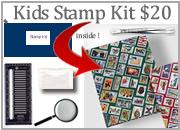
Boscastle Supplies Creates Junior Stamp Collecting Starter Kit to Help Get Kids Involved in the Hobby and Donates Kits to Youth Desk at the National Postage Stamp Show in Toronto


FOR IMMEDIATE RELEASE - April 08, 2011 - Boscastle Supplies, (www.boscastlesupplies.com) is one of North America's leading online stores for stamp collecting and coin collecting supplies and accessories, and is pleased to announce that they now provide a Stamp Collecting Starter Kit especially created for juniors.
 
Several of these Boscastle Supplies Junior Stamp Collecting Starter Kits have been donated to the Youth Table at the Spring National Postage Stamp Show, Toronto, April 8, to April 10, 2011. The kits will be given out to random kids who arrive at the Youth Table during the show.

Starting to collect stamps is an easy, inexpensive and enjoyable hobby. And with the Boscastle Supplies Junior Stamp Collecting Starter kit, any child can start a stamp collection and turn it into a life-time hobby.

“Parents and grandparents are always looking for new ways to energize their kids about reading, writing and learning,” said Susan Peters, Owner, Boscastle Supplies. "But they ask how do I get kids to start stamp collecting?  What materials do they need? And where can they buy them?" So purchasing a ready to go stamp collecting starter kit is the perfect answer.”

The Boscastle Supplies Stamp Collecting Starter Kit comes complete with all the materials necessary to get easily started in the hobby. The kit contains: 

·         A quality stamp album stockbook that doesn’t require stamp hinges or mounts to stick the stamps in. These are perfect for kids as it will allow them to rearrange the stamps on pages according to size, country or theme;
·         A hand held magnifying glass that will be useful for examining stamps close up;
·         A pair of junior sized stamp tongs, for carefully handling the stamps;
·         A perforation gauge to learn how to measure the perforations on the side of the stamp
·         6 glassine envelopes for storing swaps, duplicates, doubles or spare stamps
·         And, a safe and secure plastic storage case with zipper to keep all the stamp collecting supplies together.

Susan Peters added "We gave a few of our kits to the National Stamp Show organizers to pass on to a random selection of kids at the Youth Table at the Toronto Show because we believe any way to get kids hooked to stamp collecting at an early stage is a good thing."

About Boscastle Supplies

Boscastle Supplies is one of North America's leading online Web stores for stamp collecting and coin collecting supplies and accessories, carrying a complete range of albums, pages, protectors and accessories for all the needs of stamp and coin collectors and postcard and medal collectors. We carry products from all the leading manufacturers including; Lindner, Davo, Lighthouse, Stanley Gibbons, Safe and Unisafe. Boscastle Supplies is a Proud Member of the Canadian Stamp Dealers Association - CSDA, The Royal Philatelic Society of Canada – RPSC, The Royal Canadian Numismatic Association – RCNA, The Philatelic Traders Society – PTS, The American Philatelic Society – APS.  For more information, please visit, www.boscastlesupplies.com or call 1-888-505-7121 or email susan@boscastlesupplies.com

Thursday, April 7, 2011

PHILATELY WILL GET YOU EVERYWHERE

GEORGE V had one of the most impressive collections in history while more recent devotees include John ­Lennon, Freddie Mercury and Sophie Ellis Bextor. 

We are  talking about stamp collecting, or philately as it is termed by those who know their Penny Blacks from their Inverted Jennys.

Lennon and Mercury might seem unlikely fans because - let’s not mince words - collecting stamps is not ­considered the most rock ’n’ roll of pursuits. In fact in many minds ­philately equals fusty.

It’s considered the domain of the anoraky obsessive who sits in their bedroom sticking “treasures” into albums while poring over catalogues with a magnifying glass. A taste for stamp collecting is something to be confided quietly not sung from the rooftops.

According to experts at Stanley Gibbons, the world’s biggest dealers, it doesn’t have to be this way. The hobby is on the increase and, internationally, there is a veritable boom. Stamps are the third most traded commodity on eBay and prices are going sky high. In the UK the reason for this is partly because the baby boom generation, who took up ­philately at school, are returning to the hobby in their retirement.

“We go to a retirement show every year and we are now inundated with people who come up to us and say: ‘Wow, Stanley Gibbons, I remember you guys when I was a kid. How do I get back into stamp collecting?'” says Keith Heddle, director of sales and marketing at Stanley Gibbons. 
 
“These are people with disposable incomes who also often have an emotional connection to stamp ­collecting because their fathers used to travel and they would send back letters or postcards. So while their fathers may no longer be alive, the hobby is a way to link back to them and to their childhood.”

Hugh Jefferies, editor of Gibbons Stamp Monthly, refers to himself as a classic baby boomer but he has not so much returned to philately as kept it up for 50 years. He is also the fourth generation of his family to collect stamps. He believes that the ­economic climate is playing its part in the ­pursuit’s surge in popularity


“Stamps have always done well when the general economy is a bit dodgy,” he says. “They’re seen as a better investment than putting your money into a building society and earning 0.01 per cent.”

N ow there is also the demand for stamps from such countries as China and India. In China, Chairman Mao banned stamp collecting for its bourgeois connotations but since his death in 1976 and with the rise of Chinese entrepreneurs, it has been going from strength to strength. The country is now home to 18 million collectors.

“What happens when economies open up and there’s an expanding middle class is that people start buying their stamps back,” says Jefferies. “So a lot of stamps from China, the Middle East and India are all leaving Europe and going back to the ­countries they originated from and when this happens, prices rise.”

“In China stamps are breaking records every month,” says Heddle. “They keep being sold at auction for more and more money. The interest here is primarily in Chinese stamps, and particularly pre-Revolutionary stamps which are things of beauty and craft whereas Communist ones tend to be utilitarian.”

Interestingly, equating collecting with anorak types is a peculiarly ­British association which does not happen elsewhere. 

“In India for example, where the stamp market is going through the roof, there is no stigma attached to it,” says Heddle. “Actually, there’s the reverse. There’s a degree of pride in collecting things. The same is true in other European countries such as Italy. I was at a stamp show 18 months ago in Rome and I was gobsmacked by the number of beautifully dressed thirtysomethings coming around, checking out the prices of stamps on their iPads and smart phones and then coming over to buy. Having a rare stamp in Italy is rather like having a fast car. It’s a trophy. And I was also amazed that on the evening of the stamp fair how many couples were ­milling around. In the UK you can’t imagine many young-ish couples ­turning to each other to say, ‘It’s Friday night. We’ve got nothing on. Do you fancy popping down to the stamp show?'”

Perhaps it is time for a change of attitude in the UK. It would no doubt be welcomed by writer Simon ­Garfield, author of The Error World: An Affair With Stamps, who has been collecting since he was a child.
He says of the hobby: “There is a risk that you come across as a slightly sad individual so you have to keep things a little bit private.”

Garfield “outed” himself in his book which charts his complicated ­emotional attachment to stamp ­collecting and concludes with the sale of his collection for the healthy sum of £40,000. 

“I did ok out of it. It was more than I had paid for them,” he says.

Whether collecting is a good investment is an issue that divides opinion, however. Certainly some very rare stamps have gone for huge prices. 

“We sold Britain’s rarest stamp last year. A very dull-looking stamp called the Six Pence IR Official which went for £375,000,” says Heddle. “Rare stamps are the world’s most valuable commodity by weight.”

But Garfield warns that stamp collecting is not necessarily the best route if you are hoping to generate a tidy nest egg.

“You have to know what you’re doing to make money out of stamp collecting,” he says.

“Inevitably the stamps that go up in value are the stamps that are very expensive to begin with and very hard to get hold of. All the attics have been emptied now and while someone might find an odd rare stamp, no one is going to find an unfolded sheet of pristine stamps from 1844 and be made a billionaire overnight. It is just not going to happen.”

Stamps which fetch a lot of money tend to be ones of the highest ­quality and which were either made more than a century ago (the first stamp, the UK’s Penny Black, was issued in 1840) or are deemed an “error stamp” where, as Jefferies puts it, “things have gone wrong. Stamps printed in the wrong colour or with the Queen’s head printed upside down, for example”.

“These types of stamps are very rare,” explains Garfield, “whereas if you bought anything from the Post Office over the past 30 years, the chances are that they are worth the same or less than you paid for them because ­millions were issued.

“People will be buying the new Prince William and Kate Middleton engagement stamps thinking they will be an investment but that’s what people thought about the ­Silver Jubilee in 1977 and they’re only worth a few pounds now. 

“Collecting can be quite a risky endeavour and really it’s one you do out of love.”

Garfield says he, like many collectors, started at school. “This was the Sixties,” he explains, “and there wasn’t much else to do.

“There weren’t computers or video games, just the weekly trip to the cinema, reading or playing football. Stamp collecting was encouraged because it was safe and reason­ably intellectual. 

“You could learn a lot about different countries through the stamps.”

He too bel­ieves that many people are taking up the hobby again as a way to “recapture one’s lost youth” but explains that much of the appeal lies in “the thrill of the quest, the desire to hunt down that really rare stamp that you read about when you were at school and there’s almost the feeling that when you’ve got it you’re not so interested any more and you move on to the next one”.

Garfield experiences the “occasional pang of regret” (although not financially) at having sold his collection and says the urge to collect anything is difficult to explain. “Those who don’t have the urge to collect often think the rest of us are bonkers, whereas collectors understand other collectors. 

“Take the character of Comic Book Guy in The Simpsons. There’s a great line where he says: ‘I’ve dedicated my life to collecting comic books and now there’s only time to say, life well spent!’ It’s not a sentiment shared by all.”

Read more: http://www.express.co.uk/features/view/239152/Stamps-Licking-the-marketPhilately-will-get-you-everywhere#ixzz1IrT5sijO

Wednesday, March 30, 2011

STAMP COLLECTING: THE FIRST CLASS HOBBY THAT HAS THE MARKETS LICKED

STAMP collecting is enjoying a resurgence at home as baby boomers revive their childhood hobby.
It is also seeing growing interest abroad, particularly among the Chinese who are not only interested in China’s domestic stamps, but also British rarities such as the Penny Black.


It is good news for Stanley Gibbons which remains the world’s pre-eminent name in stamp collecting.

Britons were the first to get the stamp collecting bug, but it is good news for the company that the Chinese have followed suit.

We should be delighted at their enthusiasm for what was once regarded as a peculiarly British hobby.

After all, imitation is the sincerest form of philately.

Source: http://www.express.co.uk/blogs/post/45962/blog/2011/03/29/237494/Stamp-collecting-The-first-class-hobby-that-has-the-markets-licked